Saturday, May 4, 2019

Stephen Clark - Could consciousness evolve ?....No.


Tiff's of Stephen Clark's essay, Could consciousness evolve ?

Click on each for a larger view 


Monday, March 25, 2019

Can Modern Science and Evolution be Theologically Salvaged ?


Modern philosopher Paul Tyson asks in a paper "Can Modern Science be Theologically Salvaged ?”

Not really. He reflects on Conor Cunningham’s brilliant book, Darwin’s Pious Idea, which is to date the finest reconciliation of evolution with serious, philosophically informed orthodox Christianity…but, in the end, says Tyson, modernity and liberalism have rendered science too metaphysically bankrupt to hold real Truths.

Here are some fine extracts from the essay HERE


….scientific knowledge is modernity’s functional metaphysics and that modernity’s metaphysical integrity—and this is not science itself—is intellectually moribund.For within a frame of belief premised on the acceptance of an entirely immanent nature and on the nominalist subject’s internally situated epistemological capacities, the modern knower can have no certain knowledge of objective reality. So the modern approach to truth—having turned its back on faith, participation, revelation, and certainty—redefines truth to mean, not a genuine knowledge of reality, but rather a probable and ever-revisable psycho- social construct which is only ‘true’ because it is instrumentally useful to us .

We have replaced reality with the legal fiction of empirical objectivity, and we have replaced truth with the instrumental criteria of pragmatic utility. Further, modernity has replaced meaning—a notion not amenable to the terms of empirical objectivity—with the syntax of language and with the epiphenomenal subjective belief-secretions of culture. 

Thus modernity’s theoretical premises hold that truth and meaning are functions of power, use, and fiction. What truth really is, is instrumental power. What meanings really are, are imagined fictions that have some psycho-bio- social use when overlaid upon the meaningless objectivity of the world, understood in probabilistic, empirical terms. 

it is enormously philosophically loaded: all the terms of its materialistically reductionist methodology betray prior existential commitments and a set of assumed metaphysical, methodological, and epistemological assumptions. 

For it is simply the case that truth and meaning cannot be functionally dispensed with if we are to remain, in normal, daily life, recognizably human. So idols must be fashioned out of tangible and controllable materials to stand in for truth and meaning so that we have something graspable to orientate value, choice, identity, and meaning in our lives. This collective worship—as with all public cultus— legitimates its way of life and upholds the continuity of its life-form over time. And it is the pseudo-scientists—those who speak in the name of science to tell us what the truth about reality is, what the real meaning of our lives is, and what our human values and cultural narratives really amount to—who are the priests of our secular, materialist public cultus. 


Reducing reality to only having meaning within a reductively materialist metaphysical frame is a move that rests on an existential preference that entails the self-defeating implication that all existential preferences and metaphysical convictions must be equally meaningless.
As prior, one must have faith in them rather than seek to prove them in derivative terms. This modern urge for the proof of what Aristotle calls “the primitives” is at the core of modernity’s deep irrationality and intellectual futility. This modern refusal to ground reason in a living and grateful faith in meaning and truth is at the core of its hubristic folly and its hopelessly disintegrative approach to knowledge. 

For where first philosophy comes before science, then the important questions of truth and value must not be determined by science, but rather the use and meaning of science must be determined by theology—that is, by a divinely revealed, analogically framed apprehension of real reality. 


….our culture’s commitment to liberalism in relation to religious beliefs—the privatisation of religious belief itself—means that practically, it is only meaningless and merely instrumental ‘facts’ that we now can collectively believe in as publically true. 
Science is never just science to us moderns, but it is the integral public discourse of modern liberalism. Modern liberalism says that science is one thing—just about value neutral facts—and each person, be they religious or not, interprets the meaning of their own subjective experiences and decides what values they will embrace entirely on the grounds of their own freedom of conscience. 
I cannot see that Christianity can do without the belief that the whole of nature still needs radical redemption. I find I cannot dispense with the Pauline notion that the whole of creation was subjected to futility by sin and is in travail waiting for its full redemption, and the church is the sacrament and foretaste of this radical eschaton in which all of material reality is to be caught up. 
Yet the idea central to modern scientific natural history is that things have always been the way they now are, from the lifeless and meaningless beginning of time so many billions of years ago, and will always be this way until the equally lifeless and meaningless end of time, so many billions of years hence. Modern naturalism recognizes only one age, only one nature. Life is a strange and transitory visitor in such a picture of reality. Without some sort of true meaning to Eden, the radicality of goodness in creation, which persists but is marred by sin, death, scarcity, and disease, is lost, and the radical eschatological horizon of total redemptive hope for nature is also lost. 


If we are to hold onto any real notion of Eden we cannot simply accept the one age, one nature view basic to modern naturalism. But any real notion of Eden cannot be understood in scientific terms; there can be no recourse to Creation Science here. For the logic of fundamentally different orders of nature which are at the alpha and the omega of the biblical narrative makes any prelapsarian order of nature as inaccessible to the knowledge categories of the present natural order as is the post-eschaton natural order.

 This logic of different natural orders is, for all intents and purposes, the same as the logic of alternative universes. 
Hence myth and irreducibly symbolic imagery are the only revealed access we have to both of those ages (or different universes). 

So it cannot be avoided that any commitment to Eden and to different natural orders is going to be a stumbling block to the one age/nature assumption of natural history, which is simply presupposed by modern science. Equally, any reduction of Christian doctrine in order to fit a one age/nature understanding of natural history is going to render the cosmogenic, cosmological, and teleological tropes of Christian belief’s sacred narrative as having no actually true redemptive meaning for us who seek to inhabit this poignantly beautiful veil of tears in hope.


John Henry Newman has said : 
“It is not reason that is against us, but imagination... The ways in which we ‘see’ the world, its story and its destiny; the ways in which we ‘see’ what human beings are, and what they’re for, and how they are related to each other and the world around them; these things are shaped and structured by the stories that we tell, the cities we inhabit, the buildings in which we live, and work, and play; by how we handle – through drama, art and song – the things that give us pain and bring us joy. What does the world look like? What do we look like? What does God look like? It is not easy to think Christian thoughts in a culture whose imagination, whose ways of ‘seeing’ the world and everything there is to see, are increasingly unschooled by Christianity and, to a considerable and deepening extent, quite hostile to it.” 

The imaginative landscapes of cosmogonies are very culturally powerful, and we should think very carefully before we concede truth to the assumptions of a modern, naturalistic cosmogeny. 


Jacques Ellul, too—no fundamentalist by any measure—sees that in all our modern scientific sophistication, we cannot better the Genesis myth, and we do it a terrible injustice if we seek to interpret it in a manner compatible with modern science. 
I suspect that modern science is too deeply embedded in a ‘one age’ imaginative mythos of originary contest and nihilistic materialism to contain insights compatible with the truths of Christianity. 
Sociologically, modern science’s cosmogenic speculations, cosmological assumptions, and teleological nihilism, are foundational to modern liberalism and modern secular reason. 
For these reasons I do not think modern science, as inextricably enmeshed with modernity as it is, can be accepted if one believes that Christ is the alpha and the omega of all that is, and if one is to think about nature and reality in the light of divine knowledge which is given (and hence nothing we own, possess, or stand over) to us by the grace of God. 
I think we have a problem with the operational scope and methodological assumptions of modern science itself, and with the implicit natura pura frame of interpretation which cannot be simply extracted from modern science—and in the final analysis, I do not think modern science can be theologically salvaged.

* See Louise Dupré, Passage to Modernity,  and Goetz & Taliaferro, Naturalism, 2008. The notion that there is a discrete nature and a discrete super-nature, and functionally only a ‘pure’ nature without any participation in a transcendent dimension prior to and beyond the directly tangible, is the functional foundation of modern science. Modern science works within this anti-metaphysical cosmology. This cannot be squared with any orthodox doctrine of creation. The science that is produced from within the operational framework of natura pura, then, should not be expected to align with Christian faith regarding the nature of nature, the meaning of human life, and the alpha of primeval goodness and the omega of redemptive glory which is the origin and teleology of creation as understood by the Christian faith. 


Friday, February 1, 2019

The case for life after death, philosophical and scientific proofs


Outside of religion, there are numerous philosophical arguments for the existence and survival of the soul.

Most are pretty complex, but a few quick ones :

A) Berkeley argues that the soul is one, simple, immaterial spirit, and, therefore, immortal. Body is compound, divisible, and therefore corruptible or perishable. The soul is incorporeal and under compostable, and therefore, immortal.

You see, the soul, or spirit, is that it does not have quantifiable, countable parts as matter does. You can cut a body in half but not a soul; you can't have half a soul. It is not extended in space. You don't cut an inch off your soul when you get a haircut.

Since soul has no parts, it cannot be decomposed, as a body can. Whatever is composed (of parts) can be decomposed: a molecule into atoms, a cell into molecules, an organ into cells, a body into organs, a person into body and soul. But soul is not composed, therefore not decomposable.

B) Martmeau gives the following metaphysical argument for immortality of the soul. Death, in its physiological aspect, is simply a case of transformation of energy. On death, the body is decom­posed into its elements, and the vital forces of the organism are dissipated. But these forces, according to the law of Conservation of Energy, are not totally lost.

Now, the law of Conservation of Energy either includes mental energy or excludes it. If it applies to physical energy only, then the mind or soul is independent of matter, and therefore may continue after death. The soul is not affected by the dissolution of the body.

If, on the other hand, the law applies to physical as well as mental energy, then mental energy is not absolutely lost after death, but continues to exist in some form or other, just as physical energy is not lost. Thus immortality of the soul is not inconsistent with the law of Conservation of Energy.

C) There’s the argument from consciousness :

The mind and brain are two separate things.

Mental things share nothing — nothing — in common with matter.

Thoughts are intentional (refer to other things), private, dimensionless, massless, not composite, etc. Matter is non-intentional (doesn’t inherently refer to anything else), public, has dimensions and mass, is composite, etc

You cannot weigh a thought, a memory does not have height, it is not extended into space.

Consciousness cannot be an emergent property of the brain because consciousness is a subjective experience and that is fundamentally different from any physical process. No description of a physical process however detailed can ever tell a color blind person what the color blue looks like.

The immaterial cannot arise from material. So,

(1) Consciousness exists.
(2) No theory exists for how consciousness can arise from the physical.
--> (3) Therefore, there must be more to the world than the physical.

And so it seems plausible that
(4) A non-physical object (e.g. soul) might imbue certain materials (e.g. brains) with consciousness.

D) One last argument comes from Plato, I quote him from the Republic :
  1. Evil is all that which destroys and corrupts. . .
  2. Each thing has its evil . . . for instance, ophthalmia for the eye, and disease for the whole body, mildew for corn and for wood, rust for iron . . .
  3. The natural evil of each thing . . . destroys it, and if this does not destroy it, nothing else can . . . 
  4. (a) for I don't suppose good can ever destroy anything,
  5. (b) nor can what is neither good nor evil,
  6. (c) and it is certainly unreasonable . . . that the evil of something else would destroy anything when its own evil does not.
  7. Then if we find something in existence which has its own evil but which can only do it harm yet cannot dissolve or destroy it, we shall know at once that there is no destruction for such a nature. . . .
  8. the soul has something which makes it evil . . . injustice, intemperance, cowardice, ignorance. Now does any one of these dissolve and destroy it? . . .
  9. Then, since it is not destroyed by any evil at all, neither its own evil nor foreign evil, it is clear that the soul must of necessity be . . . immortal.


There are also scientific reasons, famous neuroscientists like Penfield, or Noble winner Eccles thought they proved the mind uses the brain like an instrument.


One of the pioneers in the field of neuroscience was Wilder Penfield. In his fascinating book The Mystery of the Mind, he write
s the following:

“When I have caused a conscious patient to move his hand by applying an electrode to the motor cortex of one hemisphere, I have often asked him about it. Invariably his response was: ‘I didn’t do that. You did.’

When I caused him to vocalize, he said: ‘I didn’t make that sound. You pulled it out of me.’ When I caused the record of the stream of consciousness to run again and so presented to him the record of his past experience, he marveled that he should be conscious of the past as well as of the present.

 He was astonished that it should come back to him so completely, with more detail than he could possibly recall voluntarily. He assumed at once that, somehow, the surgeon was responsible for the phenomenon, but he recognized the details as those of his own past experience.”


Penfield goes on to note that “There is no place in the cerebral cortex where electrical stimulation will cause a patient . . . to decide” .

In light of his work as a neuroscientist, Penfield concludes the following: “For my own part, after years of striving to explain the mind on the basis of brain-action alone, I have come to the conclusion that it is simpler (and far easier and logical) if one adopts the hypothesis that our being does consist of two fundamental elements”


After years of experiments Noble prize winning neuroscientist Dr.  Eccles came to a similar conclusion :

“I maintain that the human mystery is incredibly demeaned by scientific reductionism, with its claim in promissory materialism to account eventually for all of the spiritual world in terms of patterns of neuronal activity. This belief must be classed as a superstition. . . . we have to recognize that we are spiritual beings with souls existing in a spiritual world as well as material beings with bodies and brains existing in a material world.” 


Or Near Death Experiments, these people have had extroidinary, life changing experiences….with ZERO brain activity !

There've been hundreds of NDE studies, l
ike the Lancelot studies HERE, which have been gone over endlessly, 

“I So we have to conclude that NDE in our study was experienced during a transient functional loss of all functions of the cortex and of the brainstem. 

It is important to mention that there is a well documented report of a patient…with all blood drained from her head, with a flat line EEG, with clicking devices in both ears, with eyes taped shut, and this patient experienced an NDE with an out-of-body experience, and all details she perceived and heard could later be verified."


Is the brain necessary ? That’s the question Dr Lorber wants answered, HERE is a math genius….with no brain !


And THIS man has NO neuronal structure, yet live an entirely normal life !


Or look at Quantum Physics, sure, there’s alot of new age woo when it comes to it, but many of the greatest have privileged mind above matter :

“I regard consciousness as fundamental. I regard matter as a derivative of consciousness. We cannot get behind consciousness. Everything that we talk about, everything that we regard as existing postulates consciousness.”

– Max Planck the originator of quantum theory.

“Consciousness cannot be accounted for in physical terms. For consciousness is absolutely fundamental. It cannot be accounted for in terms of anything else.”
- Schroedinger

He goes on to say, “I venture to call [mind] indestructible since it has a peculiar timetable, namely mind is always now.”


In other words, Mind is an indivisible unity, it cannot be destroyed, and it is timeless. 

Some of the most prestigious physicists working today agree,
physicist Richard Conn Henry of Johns Hopkins University states unequivocally that the universe is entirely mental (only consciousness is real) and proceeds to resolve the paradoxes of quantum mechanics and cosmology in this way.

“Why do people cling with such ferocity to belief in a mind-independent reality? It is surely because if there is no such reality, then ultimately (as far as we can know) mind alone exists. And if mind is not a product of real matter, but rather is the creator of the illusion of material reality (which has, in fact, despite the materialists, been known to be the case, since the discovery of quantum mechanics in 1925), then a theistic view of our existence becomes the only rational alternative to solipsism.”
           

- The Universe is immaterial — mental and spiritual.
Richard Conn Henry


The simple fact is that quantum mechanics needs consciousness to explain physics. Need proof ? Here’s four peer reviewed articles proving it :

  1. Kim, Y.-H. et al. (2000). A Delayed Choice Quantum Eraser. Physical Review Letters 84, pp. 1–5. The authors show that observation not only determines the reality observed at present, but also retroactively changes the history of what is observed accordingly. This is entirely consistent with the notion that reality is fundamentally a story playing itself out in mind.
  2. Gröblacher , S. et al. (2007). An experimental test of non-local realism. Nature 446, pp. 871-875. The authors show that reality is either entirely in consciousness or we must abandon our strongest intuitions about what objectivity means. Physicsworld.com, in a related article, went as far as to claim that ‘quantum physics says goodbye to reality.’
  3. Lapkiewicz, R. et al. (2011). Experimental non-classicality of an indivisible quantum system. Nature 474, pp. 490–493. The authors show that, unlike what one would expect if reality were independent of mind, the properties of a quantum system do not exist prior to observation. Renowned physicist Anton Zeilinger, in a related New Scientist article suitably titled “Quantum magic trick shows reality is what you make it,” is quoted as saying that “there is no sense in assuming that what we do not measure about a system has [an independent] reality.”
  4. Xiao-song Ma et al. (2013). Quantum erasure with causally disconnected choice. Proc. Natl. Acad. Sci. USA 110, pp. 1221-1226. Again, the authors show that no naively objective view of reality can be true, which is consistent with the notion that reality is fundamentally subjective. A less-technical explanation of the experiment in this paper, as well as its results, can be found here.


Finally, simple intuition. What else is the meaning of love, but an  acknowledgment that the other will live forever.....


Monday, December 10, 2018

Science will never explain consciousness. Ever.


Science has explained everything else, surely it will explain consciousness right ?
No.
Why ? Because of what the philosopher Ed Feser calls the “lump under the rug” fallacy :
"Suppose the wood floors of your house are filthy and that the dirt is pretty evenly spread throughout the house.  Suppose also that there is a rug in one of the hallways.  You thoroughly sweep out one of the bedrooms and form a nice little pile of dirt at the doorway.  It occurs to you that you could effectively “get rid” of this pile by sweeping it under the nearby rug in the hallway, so you do so.  The lump under the rug thereby formed is barely noticeable, so you are pleased.
You proceed to sweep the rest of the bedrooms, the bathroom, the kitchen, etc., and in each case you sweep the resulting piles under the same rug.  When you’re done, however, the lump under the rug has become quite large and something of an eyesore.  Someone asks you how you are going to get rid of it.  “Easy!” you answer.  “The same way I got rid of the dirt everywhere else!  After all, the ‘sweep it under the rug’ method has worked everywhere else in the house.  How could this little rug in the hallway be the one place where it wouldn’t work?  What are the odds of that?”

Naturally, the same method will not work in this case, and it is precisely because it worked everywhere else that it cannot work in this case.  You can get rid of dirt outside the rug by sweeping it under the rug.  You cannot get of the dirt under the rug by sweeping it under the rug.  You will only make a fool of yourself if you try, especially if you confidently insist that the method must work here because it has worked so well elsewhere.

Now, the “Science has explained everything else, so how could the human mind be the one exception?” move is, of course, standard scientistic and materialist shtick.  But it is no less fallacious than our imagined “lump under the rug” argument.
Here’s why.  Keep in mind that Descartes, Newton, and the other founders of modern science essentially stipulated that nothing that would not fit their exclusively quantitative or “mathematicized” conception of matter would be allowed to count as part of a “scientific” explanation.  Now to common sense, the world is filled with irreducibly qualitative features — colors, sounds, odors, tastes, heat and cold — and with purposes and meanings.  None of this can be analyzed in quantitative terms.
To be sure, you can re-define color in terms of a surface’s reflection of light of certain wavelengths, sound in terms of compression waves, heat and cold in terms of molecular motion, etc.  But that doesn’t capture what common sense means by color, sound, heat, cold, etc. — the way red looks, the way an explosion sounds, the way heat feels, etc.  So, Descartes and Co. decided to treat these irreducibly qualitative features as projections of the mind.
The redness we see in a “Stop” sign, as common sense understands redness, does not actually exist in the sign itself but only as the quale of our conscious visual experience of the sign; the heat we attribute to the bathwater, as common sense understands heat, does not exist in the water itself but only in the “raw feel” that the high mean molecular kinetic energy of the water causes us to experience; meanings and purposes do not exist in external material objects but only in our minds, and we project these onto the world; and so forth.  Objectivelythere are only colorless, odorless, soundless, tasteless, meaningless particles in fields of force.


In short, the scientific method “explains everything else” in the world in something like the way the “sweep it under the rug” method gets rid of dirt — by taking the irreducibly qualitative and teleological features of the world, which don’t fit the quantitative methods of science, and sweeping them under the rug of the mind.  And just as the literal “sweep it under the rug” method generates under the rug a bigger and bigger pile of dirt which cannot in principle be gotten rid of using the “sweep it under the rug” method, so too does modern science’s method of treating irreducibly qualitative, semantic, and teleological features as mere projections of the mind generate in the mind a bigger and bigger “pile” of features which cannot be explained using the same method."


Wednesday, November 7, 2018

The five cosmic fractures and their healing


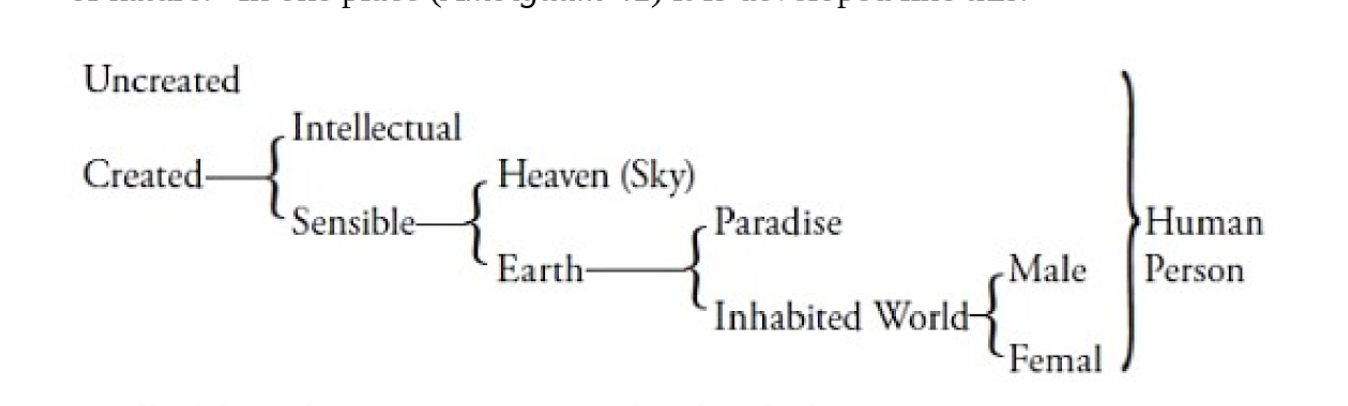
The Cosmos is fractured in five distinct ways. 

We now live with the dualities of created and uncreated, intelligible and sensible, heaven and earth, paradise and universe, male and female.


Man, being microcosm and mediator of the spiritual and material, is called to heal these divisions within himself.

To unite heaven and earth by virtue, to unify the tangible and intelligible worlds by acquiring angelic gnosis, and to reunite by love the created and the uncreated.


We heal the Cosmos, Being itself, by letting God's grace overcome these divisions within our own being.

So says St Maximus at least....


St. Gregory of Nyssa, it should be noted, also made a similar distinction in hisOn the Soul and Resurrection , chapter 10;:

“When we have put off that dead and ugly garment which was made for us from irrational skins (when I hear ‘skins’ I interpret it as the form of the irrational nature that we have put on from our association with passion), we throw off every part of our irrational skin along with the removal of the garment.

These are the things which we have received from the irrational skin:sexual intercourse, conception, childbearing, dirt, lactation, nourishment, evacuation, gradual growth to maturity, the prime of life, old age, disease and death.”


The place St Maximus speaks of this is in Ambiguum (Difficulty) 41.

The other place is in the first part of his short work on the Eucharistic liturgy, his Mystagogia.


Basically his theory of divisions sets up a set of echoing correspondences in the Church.

Sanctuary/nave is reflected in invisible/visible, heaven/earth, soul/body, mind/reason, New Testament/Old Testament, meaning/text. So the movement between sanctuary and nave in the liturgy interprets and is interpreted by movement between the other divisions.


So the liturgical movement celebrates the healing of the five divisions.

Andrew Louth goes into more detail :

“Difficulty 41 is built up around this notion of the divisions of being. According to the Saints, Maximus begins (an expression that always means that he in introducing a traditional notion, and often something that can be precisely paralleled in earlier Fathers, as here), there are five divisions of being.

The first divides uncreated nature from that which is created. The second divides created being into that perceived by the mind and that perceived by the senses. The sensible realm is further divided into heaven and earth; earth into paradise and the inhabited world (what the Greeks called the oikoumene).

Within the inhabited world human beings dwell and these are divided by sex into male and female. But the human being is not just the last stage in this structure, it is, as he says, ‘the laboratory in which everything is concentrated and in itself naturally mediates between the extremities of each division’, for human beings are found on both sides of each division: they belong in paradise but inhabit the inhabited world; they are earthly and yet destined for heaven; they have both mind and senses; and though created, they are destined to share in the uncreated nature by deification.

All the divisions of the cosmos are reflected in the human being, so the human being is a microcosm, a ‘little cosmos’ (a term Maximus does not use explicitly here, though he does elsewhere).

As microcosm, the human person is able to mediate between the extremes of the cosmos, he is a ‘natural bond’ (physikos syndesmos), and constitutes the ‘great mystery of the divine purpose’ (1305B). Maximus then develops this work of mediation.

The first step is to transcend sexual division through ‘the most dispassionate relationship to divine virtue’. As Maximus makes clear here and later on, the division of the sexes is not original or primordial. Maximus shares with Gregory of Nyssa a belief in the double creation of humankind: an original creation that transcends sexuality, and a second creation, embracing sexual division, that has been introduced, not because of the Fall, but with a view to the Fall, that will exploit this division and turn it into an opposition, even a warfare. Maximus does not believe in what the poet Amy Clampitt has called ‘the archetypal cleft of sex’.

Second, by a ‘way of life proper and fitting to the Saints’, the human person unites paradise and the oikoumene to make one earth. Then, by imitating by virtue the life of the angels, the human person unites heaven and earth. Then, by being able to perceive the logoi of the created order, the distinction between the intelligible and the sensible falls away.

And finally, by uniting created nature with uncreated nature through love, the coinherence or interpenetration of God and the creation becomes apparent.

These stages recapitulate the stages of the spiritual life as Maximus understands it. In other words, through accomplishing all the stages of the spiritual life, the human person achieves, not simply union with God, but also fulfils what is the essentially human role of being the natural bond of all being, drawing the whole created order into harmony with itself, and into union with God.”

For further study see pages 53-54 of On the Cosmic Mystery of Jesus Christ: Selected Writings from St. Maximus the Confessor. Trans. Paul M. Blowers and Robert Louis Wilken.

Lars Thunberg has two superb books on this.

Torstein Theodor Tollefsen is the other guy to consult, The Christocentric Cosmology of St. Maximus the Confessor