Friday, May 31, 2024

Tibetan monks survive WW II thinking it's the netherworld


Two Tibetan peasants stumble into WWII and survive astonishing odds thinking they're in the netherworld.

This story is related in Cambodia by Brian Fawcett, page 93. It's claimed to be a true story,  and George Orwell also references the story, with different details, in his 13 October 1944 “As I Please” column.


“The two men were Tibetan peasants. In the early 1930s, they embarked on a religious pilgrimage from the area around Yusho in Eastern Tibet to Lhasa. They were intent on entering a monastery—not an uncommon practice for young men in that culture. But early in their journey, as a result of an intense snowstorm, they became lost and wandered along the Dza (Mekong) river into Southeastern China, where they were captured by bandits.

Shortly after their capture, the bandits packed up and marched into Northern China to join the Communists, taking the two young Tibetans with them. From there, the two men escaped, and, after several years in which they probably skirted the northern lip of the Tibetan plateau, blundered into Central Russia, where they fell into the hands of the Russian authorities at Tashkent.

The Germans had just invaded Russia, and the Tibetans were inducted into the Russian army and packed off to the Eastern Front as cannon fodder. Before long they were captured by the Germans—it wasn't clear whether by military misadventure or because they simply wandered away from their encampment and in behind the German lines.

Luckily, the German commandant involved in their capture didn't execute them. Instead, he had them transported to Poland, where they worked for a time in a concentration camp—Captain Surry couldn't determine which one it was, or its size, only that people were, in the words of the Tibetans, coming there "to the smoky light".

But as winter approached, and under threat of the now-oncoming Russian armies, the concentration camp was dismantled and the two Tibetans were inducted into the German Army and transported to Normandy.

There, we know, once again they fell into the hands of a new authority. Captain Surry went over the events again and again with the Tibetans, convinced that the riddle of their unlikely survival and their profound, elastic passivity in the face of hardship after hardship was eluding him.

The modern world had done its worst to them, and yet had done nothing at all. The Tibetans were neither stupid men nor, on their own terms, were they ignorant.

Finally, it came to him. For ten years, these two men had believed that they were dead.

Reluctantly, the Tibetans confirmed his theory and elaborated. In their terms, their ordeal had been a test of their being, and a means, they hoped, of gaining Nirvana, however confusing and unorthodox those means were.

They had survived because from the very first days they had believed that they were dead men caught in an unpredictable Bardo, or netherworld.

To the Tibetans, bodily survival had not been a goal, since they believed that they were already dead.

They were traversing the netherworld in order to be reborn. They'd sought shelter, eaten and slept only because their bodies continued to make demands for shelter, food and sleep.”


So, when in distress, simply ask yourself: have I considered treating this problem as an otherworldly test of character in which physical survival is irrelevant?


Wednesday, May 22, 2024

Therapy, exorcism, and Parts work


Robert Falconer is an IFS therapist who recently wrote a controversial book called the Others Within US. Internal Family Systems (IFS) is the hot new therapy modality from RichardSchwartz, who wrote a forward to the book.

IFS posits that our Self is made up of many parts, like inner children, each trying there best to use old behavior patterns to protect us. These need to have their story witnessed, experience love and acceptance, and be relived of the burden their problematic behavior is trying to help with.

Falconer posits another phenomena - “unattached burdens”. These look like parts of the person’s psyche, but often have nothing to do with them, and can appear, well, demonic.

I’m trained in a few modalities. I specialize in the Ideal Parent Figure Protocol, but I’ve trained also in IFS, as well as Advanced Ego State Therapy, sometimes called “Resource therapy” created by Gordon Emmerson.

In fact, I believe I’m only one of two people in the USA trained in Resource Therapy. My bio HERE

Resource Therapy posits a number of objects, one of which seems similar to the “Unattached Burden.” Dr. Emmerson calls it an OPI. These are very rare, and still being studied. 

For Emmerson, there are two types of Introjects, internalized impressions (usually of parents/family) held by Resource States, and the much more rare, Other Personalized Introjects (OPIs).

Dr. Emmerson writes in Learn Resource Therapy Clinical Qualification Student Training Manual:

"When spoken with directly they will claim not to be a part of the personality, and unlike Resource States they can permanently leave the personality.vWhile their etiology is unclear, I find when they are negotiated with to leave they can do so without any further indication of being present. Clients show improvement and often say they feel physically lighter.”

On identifying these objects he writes,

“When an OPI is asked, "Are you part of this person?" it will respond with

something like, "No, I'm not part of her." OPIs speak about the client in the third person, "She will never amount to anything."

While some Resource States will speak about other Resource States in the third person, "I don't like that part,"there is normally an acknowledgment that the two Resource States are different parts of the same person. When talking with an OPI there is an impression that you are almost talking with someone else, and not the client.

Resource Therapy OPIs will often say things like, "I know I shouldn't be here.” “You can't make me leave,” or “I am afraid to go." Sometimes OPIs will even claim to be another person who has died.

When an OPI is negotiated to leave, the client will often report that the very

critical voice that may have been heard for years is no longer heard.”

I’ve trained with him and he has an entire modality to deal with these objects.

My own opinion?

I think “Unattached Burdens” have a venerable presence in therapy, although different in kind, some perhaps being “protectors” and “introjects” and the like, but looking closely I can see some possible "UB’s.

Think of those figures or forces in readily recognized by Freud as “daimonic” - the death instinct and ‘severe super ego.'

Or what Fairbairn described as an “Internal Saboteur” and Guntrip as the “anti-libidinal ego” attacking the “libidinal ego.” 

Recall Jung’s “negative Animus” or what Jeffrey Seinfeld simply calls the “Bad Object.”

At least a handful of theses may be the equivalent of “Unattached Burdens."

They pop up plenty of places:

Sandor Ferencz’s paper “Confusion of Tongues” and the demonic mature inner “intelligences” occupying disassociated children…

Donald Sandner and John Beebe - distinguishing between the ego-aligned complexes (those where the projected contents have been a part of the ego and been repressed) vs. the ego-projected complexes, i.e., those that are usually experienced *not as parts of the ego’s identity but rather as projected qualities in other people.

They go on about how possession of the ego by the “ego- projected” complexes leads to archetypal affects and primitive forms of a projected “daemonic trickster.”

Edmund Bcrgler’s “Daimonion," a malignant spirit, internal angatonist with uncanny power.

Heck, in the early work of Charcot and Janet, daimons were named, flattered, and their cooperation enlisted in the treatment ! Janet was fond of tricking the inner daimons. His patient Achilles “possessed” by the Devil until Janet tricked him into cooperating with the treatment and then actually taking over the actual hypnosis of the patient from within!

The respected Jungian Donald Kalsched, whom I've spoken to, in his Trauma & the Soul, has plenty of stories that sound a lot like Unattached Burdens to me….

Dr Colin Ross, former president of the International Society for the Study of Trauma and Dissociation from 1993 to 1994, actually performed a demonic exorcism, because he is so well respected he has also been able to publish peer reviewed articles on exorcism in therapy.

The famous Harvard-educated psychiatrist Dr. Scott Peck, after confronting several apparently possessed patients, eventually decided to add exorcism to the rest of his practice, with good results.

The belief in something like “non-egoic parts” needing something like "exorcism" is becoming more common.

I’ve personally spoken to “big names” who publicly would never say so, but privately believe in these objects.

Plus it's no secret more therapy modalities are incorporating spirituality and even resources from Shamanism, such as Lisa Schwartz’s Comprehensive Resource Model.

So….what do I think they are?

I haven’t the slightest clue.

But I am heartened that we are taking non-Western traditions and cultural experiences seriously with an open mind.

Ok, IF there were non-egoic parts….how?

Well, I love philosophy, but I take its conclusions pretty lightly. 

I suppose someone could invoke a form of Idealism, which quantum physics has been pointing to, and also *Donald Hoffman's quantum consciousness equations, where two seperate consciousness will combine, yet be one from a "higher frame", and still individually singular from a "lower frame.” (See below)

Plus it would make sense of the Near Death Experiences where the person reports not just seeing dead relatives, but becoming them.

Still, it’s awfully speculative, and really I simply haven’t a clue.

Find me here :

AttachmentHealingHelp.com


*See the equations explained under “Conjecture 3” of Hoffman’s paper Objects of consciousness HERE.

He explains :

“The theory of conscious agents proposes that a subject, a point of view, is a six-tuple that satisfies the definition of conscious agent. The directed and undirected join theorems give constructive proofs of how conscious agents and, therefore, points of view, can be combined to create a new conscious agent, and thus a new point of view.

The original agents, the original subjects, are not destroyed in the creation of the new agent, the new subject. Instead the original subjects structurally contribute in an understandable, indeed mathematically definable, fashion to the structure and properties of the new agent.

The original agents are, indeed, influenced in the process, because they interact with each other. But they retain their identities.

And the new agent has new properties not enjoyed by the constituent agents, but which are intelligible from the structure and interactions of the constituent agents. In the case of undirected combination, for instance, we have seen that the new agent can have periodic asymptotic properties that are not possessed by the constituent agents but that are intelligible—and thus not emergent in a brute sense—from the structures and interactions of the constituent agents.”

Monday, May 20, 2024

Attachment, God, and Ideal Parents


Jake Orthwein recently tweeted about the connection between attachment and religion, especially Ideal Parent Figure Protocol Therapy.

Basically, during an Ideal Parent Figure session, a client is asked to imagine having fictional, ideal parents while growing up.

He or she is guided through several scenes, imagining themselves as a child, where these ideal parents can provide all the things that make up a securely attached adult.

These imagined scenes involve the ideal parent providing safety, being attuned to the child, supporting, delighting, and soothing the child.

In this way, a new Internal Working Model is created that the client can bring into his relationships here and now.

By having these positive attachment experiences, new neural pathways are created and a new, secure attachment pattern is established deep in your mind and body.
The following is from Jake Orthwein's twitter:


"There is something religious about attachment and joint attention and I would like to better understand what it is.

Many people have separately noticed that doing the Ideal Parent Figure Protocol bears a striking resemblance to…well…


What’s more, it was directly adapted from Mahamudra deity yoga, in which one visualizes and sometimes becomes a deity who embodies the qualities of awakened awareness


My first experience of doing IPF directly gave rise to the intuition that attachment-related injuries are in fact basic injuries of existential meaning, experienced (in theistic terms) as alienation from god


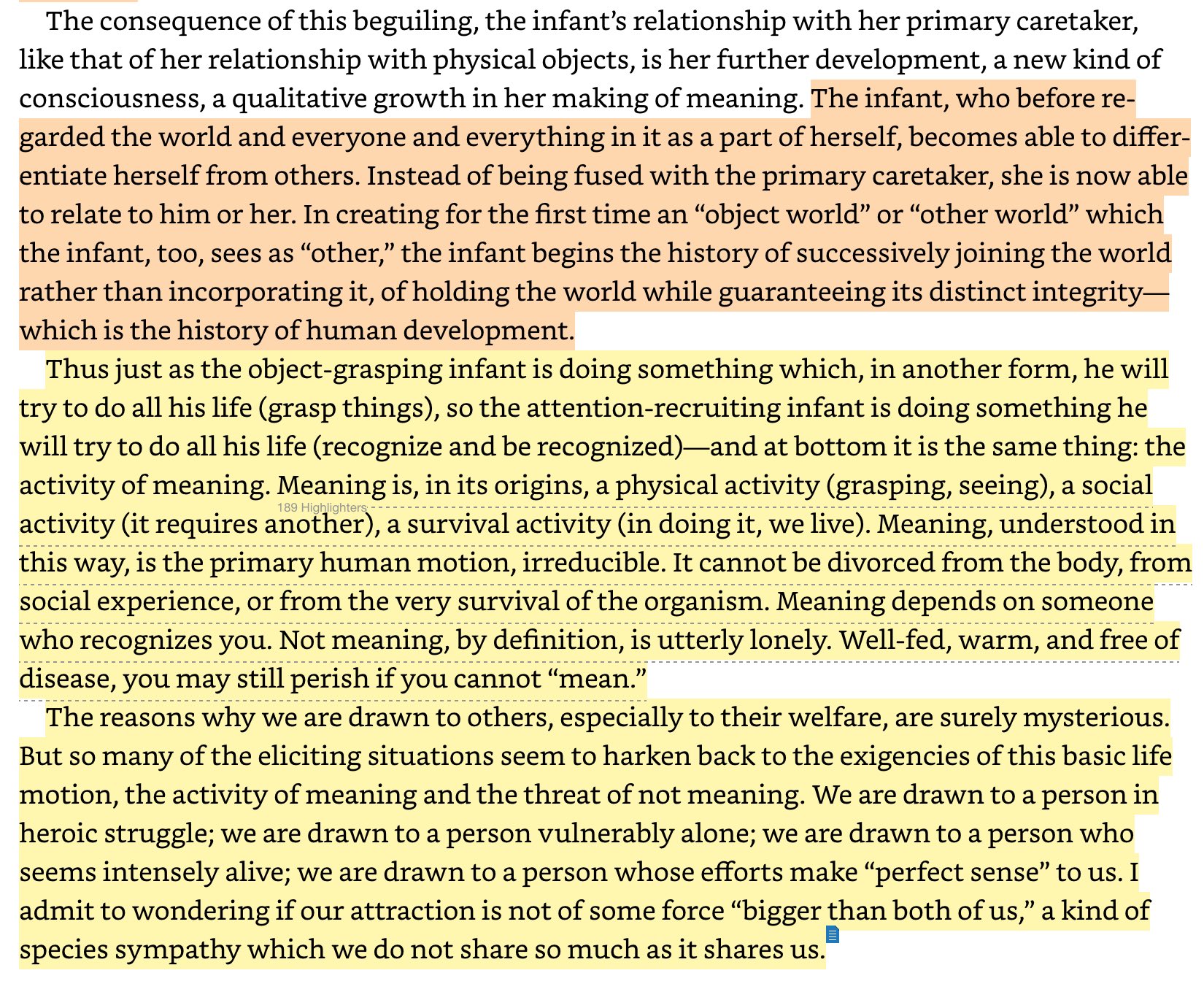
Per Kegan, existential meaning has its origins in these primordial scenes of initial differentiation from the primary caregiver, in which we express a concrete need to be recognized that will later be abstracted into our lifelong need to be seen, known, recognized


One of the ways we negotiate this transition into being individuated selves is by entering into joint attention with our parents.

These experiences of joint attention temporarily suspend our sense of separate self-consciousness, making them profoundly intimate.     


Religions also make use of joint attention, and can be thought of as exercises in orienting attention toward the highest principles (which might also (in a nontheistic idiom) be thought of as attending to the nature of awareness itself) HERE


https://twitter.com/i/status/1636601452964745216 


Joint attention is also the context in which we learn to point at things, which is where both existential meaning (meaning of life) and semantic meaning (meaning of words) develop.

God (or the ideal parent, or awareness) stands outside us, interpreting attending as significant."


Read more about pointing and meaning HERE


Jake continues:

"The claim that the attachment system sits beneath and pervasively influences later developmental achievements lends credence to the theistic claim that the proper stance toward the Ground of Being is one of personal relationship.

It’s why the questions “can I grasp” and “am I recognized” are so existentially central


But it’s also why, when grasping is surrendered, the alienation ends.


It’s why our fundamental alienation from the Ground of Being — our condition of “wrestling with God” — can be characterized in terms of “splitting” 


For help with attachment problems using the Ideal Parent Figure Protocol :


Sunday, May 5, 2024

Does the World Exist ? Probably not, and that's a good thing.


Art by SheepDen

First I write about the practical psychological consequences of such a belief, and then the mystical , scientific, and philosophical aspects of the world not existing. 

The Psychological

Often I hear people say they’re worried about “the world”. Where is the world, I ask. They usually point to a wall. “I’m worried about my neighbor,” they say. “Where is she?” They point to the wall again.

This interests me both psychologically and philosophically.

Psychologically, with clients, my intention is that their minds only entertain what is valuable; and by valuable I mean good to have done and possible to do.

So, it’s not indifference to the actual neighbor I would suggest, but indifference to the thoughts about the neighbor that are not valuable - that aren’t possible to do, and so don’t help anyone.

If we are preoccupied with thoughts of what is not possible to do, we will miss the real flesh and blood person in front of us that is possible to help.

Of course, when we are fused with our thoughts, we might believe them as an absolute truths, or iron laws we MUST obey, and then it’s difficult to separate our thoughts from reality, and instead of our mind reacting to the reality we are reacting only to our thoughts.

Acceptance and Commitment Therapy (ACT) has much in common with Buddhism; also with Vedanta and its practice of Self-Inquiry where you meditate on “Who am I.”

In ACT they practice cognitive defusion, which has three steps:

Looking at thoughts rather than from thoughts.
Noticing thoughts rather than becoming caught up in thoughts.
Letting thoughts come and go rather than holding on to them.

It also helps to ask yourself: 

Is holding on to this thought/belief helpful?
Is doing so causing me suffering or keeping me from being effective?


The Philosophical.

I’m also interested in this viewpoint philosophically. There’s even a movement now in philosophy called the “new realism” led by Markus Gabriel, you can read a review of his book Why the World Does Not Exist HERE

So, the world doesn’t exist, something poets and mystics have always known, and now scientists.

Below are quotes from all three :

"How little does man know of his Self [the one, immortal, formless substratum of all that exists], how he takes the most absurd statements about himself for holy Truth. He is told that he is the body, was born, will die, has parents, duties; learns to like what others like and fear what others fear.

Totally a creature of heredity & society, he lives by memory & acts by habits. Ignorant of his Self & his true nature, he pursues false aims and is always frustrated. His life & death are meaningless and painful, and there seems to be no way out."

- Nisargadatta Maharaj

From Eckhart’s 87th sermon HERE : 

“For in that essence of God in which God is above being and distinction, there I was myself and knew myself so as to make this man. Therefore I am my own cause according to my essence, which is eternal, and not according to my becoming, which is temporal. 

Therefore I am unborn, and according to my unborn mode I can never die. According to my unborn mode I have eternally been, am now and shall eternally remain. That which I am by virtue of birth must die and perish, for it is mortal, and so must perish with time. In my birth all things were born, and I was the cause of myself and all things….”

“The assumption that space and time exist and are real is not universal to humankind…there is practically no limit to the different ways in which people conceive of space and time.”

-Stanisław Iwaniszewski

“From an anthropological viewpoint, concepts of space and time should be viewed as cultural products (artifacts), products of thought, situated within Karl Popper's (1972) third world (Renfrew and Bahn 1991, pp. 340), but remaining embedded and embodied in physical objects, events, and processes taking place in his first world.

Therefore, there is no reason to suppose that space and time are real things that exist and can be universally and objectively perceived; rather they should be regarded as "imaginary constructs which generate the rationality of the relationship between people and their actions" (Iwaniszewski 2001, p. 3). In a similar way, all peoples create a concept of the universe, or cosmos…”

- Iwaniszewski, S. (2015). Concepts of Space, Time, and the Cosmos. In: Ruggles, C. (eds) Handbook of Archaeoastronomy and Ethnoastronomy.

“Just as the spider emits the thread (of the web) out of itself and again withdraws it into itself, likewise the mind projects the world out of itself and again resolves it into itself. When the mind leaves the Self, the world appears.

Therefore, when the world appears, the Self does not appear; and when the Self appears (shines) the world does not appear.”

- Ramana Maharshi

"O, aspirants who hide yourselves away fearing this world, nothing such as a world exists! Fearing this false world which appears to exist, is like fearing the false snake which appears in a rope."

- Ramana Maharshi

“If one wished to escape the world of perspectives one would perish.”

— Nietzsche

"What is perfection? Profound humility, which consists in the abandoning of everything visible and invisible: visible meaning everything involved with the senses; invisible meaning all thinking about them."

—St. Isaac of Nineveh

“If it is perceivable 

or conceivable 

it is not You, 

therefore discard it.”


~Nisargadatta Maharaj


THE UNBELIEVABLE by William Bronk

We are made afraid not to believe the fraud

of this world : believe or be lost.

Lost anyway.

No more to lose. Not that we ever had.

We said we had. The world said. It said,

"There is a world for having, a world to be had

only believe." Who was had ?

World,

I say no. No world.

These are not

spoken speeches. Nobody says, or to say.


But the unbelievable, which nothing believes,

says something. Listen. Says itself.

As if it were my voice. As if it were now.


What We Are by William Bronk


What we are? We say we want to become

what we are or what we have an intent to be.

We read the possibilities, or try.

We get to some. We think we know how to read.

We recognize a word, here and there,

a syllable: male, it says perhaps,

or female, talent -- look what you could do


or love, it says, love is what we mean.

Being at any cost: in the end, the cost

is terrible but so is the lure to us.

We see it move and shine and swallow it.

We say we are and this is what we are

as to say we should be and this is what to be

and this is how. But, oh, it isn’t so.


THE ELUSIONS OF DESIRE by William Bronk


I know nothing about my life except
that (call it my life) it is all mysterious.
You say, all right, come to your senses. I come.
I come to a sense other than common sense.


But I love that, too, would come there

if I could. Sense is what I love — the half
sense I find. My eyes look
out while I stay in mystery, wanting sense.


Abba Alonius, summarizes it well: “If a man does not say in his heart, in the world there is only myself and God, he will not gain peace”


When I was the stream, when I was the
forest, when I was still the field
when I was every hoof, foot,
fin and wing, when I
was the sky itself,

no one ever asked me did I have a purpose, no one ever
wondered was there anything I might need,
for there was nothing
I could not love.

It was when I left all we once were that
the agony began, the fear and questions came,
and I wept, I wept. And tears
I had never known before.

So I returned to the river, I returned to
the mountains. I asked for their hand in marriage again,
I begged—I begged to wed every object and creature,

and when they accepted,
God was ever present in my arms.
And He did not say,
“Where have you
been?”

For then I knew my soul—every soul—
has always held
Him.

~ Meister Eckhart (13th C Christian mystic)


Thursday, May 2, 2024

David Bentley Hart on Leopardi vs Nicholas of Cusa


"Children find everything in nothing, adults find nothing in everything"
-Giacomo Leopardi


In his book You Are Gods David Bentley Hart has a chapter on Nicholas of Cusa, in which he contrasts the great mystic's intuitions with the those of Leopardi, the great poet of pessimism :


"In one of the earlier passages in his Zibaldone, Leopardi reflects at considerable length upon what he takes to be a sentiment common to all of us: a sense he believes we all share of the “nullità di tutte le cose,” “the nullity of everything,” the insufficiency of every pleasure to satisfy the spirit within us, and  “our inclination toward an infinite that we do not comprehend.” It is, taken as a whole, a tour de force of psychological phenomenology. 

It also, however, begins from a logical error; for, according to Leopardi, both this persistent dissatisfaction within us and the infinity of longing that underlie it can probably be ascribed to a cause “more material than spiritual.” Which is to say, he begins by assuming a contradiction: that an infinite intention, exceeding every finite object of rational longing, could arise spontaneously from finite physical causes, without any transcendental end to provoke it as, at least, an intentional object and capacity of the rational will. 

But how, then, could we experience this tendenza at all as an actual intelligible volition beyond what lies immediately before us, and arrive at an aware- ness that it is unfulfilled? An intention without a final intentional horizon can be experienced neither as fulfilled nor as unfulfilled. 

And yet Leopardi recognizes that our desire for pleasure is limitless in duration and extent, and that we would not exist as the beings we are without it; it belongs to our substance, he says, not as a longing for this or that, but as a desire for the pleasing as such. 

And here he is quite correct. One can desire nothing finite as an end wholly in itself, but only, “as abstract and limitless pleasure.”

 “Following on one pleasure, the soul does not cease from desire for pleasure, just as it never ceases thinking, because thought and desire for pleasure are two operations equally continuous with and inseparable from our existence.”

 Indeed. But, then, what Leopardi’s reflections actually reveal is that our ability to desire anything as a purpose conceived by the willing mind is inexplicable unless we presume that the source of that desire is a tran- scendental object (real or supposed) to which our rational wills are—at least, again, intentionally—wholly adequate. 

As a matter of simple fact, all purposive human desire is animated at its most primordial level by an unremitting volition toward (for want of a better term) the divine. Cor nostrum inquietum est donec requiescat in te, to coin a phrase.

One can see, of course, why as unremittingly dour a godless genius as Leopardi would not be inclined to follow his musings to the conclusion they appear to entail. To grant that the human spirit is capable of a genu- inely infinite intentionality is already to grant that the sort of bleak materialism he presumed is at best paradoxical, at worst incoherent. If nothing else, it would mean that even that aspect of human character that seems most irrational—our inability to rest finally content in any proximate and finite end of longing—is in fact the result of a prior and wholly rational relation between human spirit and the proper end of rational freedom as such. 

That irrepressible disquiet is not merely the insatiable perversity of aimless appetite, magically positing an ever more exalted end for itself somewhere out there in the nowhere of the will’s spontaneous energies, but is rather a constant and cogent longing that apprises us of the true ultimate rationale that prompts the mind and will to seek any end at all, and therefore to be capable of recognition, evaluation, judgment, and choice in regard to proximate ends: a rationale that lies elsewhere, beyond the limits of the finite. 

This also, moreover, touches upon a very old issue within the history of Western metaphysics: the gradual discovery that infinity is not merely a name for unintelligible in- determinate extension—as was the prejudice of early Platonic, Aristotelian, and Stoic thought—nor even merely a positive rational category; rather, infinity is also a proper name for that necessary terminus of all real rational freedom apart from which neither reason nor freedom could exist. Plotinus is perhaps the first Western thinker to have grasped this explicitly. In Christian thought, it was Gregory of Nyssa who first unfolded the principle at length, and with consummate brilliance. 

But no Christian figure after Gregory, with the possible exception of Maurice Blondel, grasped the principle in all its dimensions as fully as did Nicholas of Cusa. As he writes in De visione dei: “Were God not infinite, he could not be the end for desire.” To which, of course, corresponds the reciprocal proposition that nothing desired as a limited quiddity, without any remainder of the “ever greater,” can be in itself the sole final cause prompting that desire.

Actually, the sixteenth chapter of De visione is oddly similar in some ways to that passage from Leopardi cited above, though of course radically different in intonation. You, God, says Nicholas : “are the form of every desirable thing and are that truth that is desired within every desire”;  “to taste of your incomprehensible sweetness, which becomes more delightful to me to the very degree that it seems more infinite,” is to see that, precisely because the divine is ultimately unknown to all creatures, “they might in holiest ignorance possess a greater contentment, as though amid an incalculable and inexhaustible treasure.” 

Hence, the creature’s ignorance of God’s full greatness is a “supremely desirable feasting,” for the intellect. And hence, also, it is God’s will both “to be comprehended in my possession and also to remain incomprehensible and infinite,” because he is a treasure whose end no one can desire. Neither can this rational appetite desire the cessation of its own existence. The will may long either to exist or not to exist, but appetite itself cannot desist from itself, for it “is borne into the infinite.” 

 “Indeed, intellectual desire is borne on not into that which is capable of being greater and more desirable, but into that which is incapable of being greater or more desirable. . . . Therefore, the end of desire is infinite.”

And so, says Nicholas, with exemplary precision: “Therefore you, God, are infinity itself, which alone I desire in every desire.” God shines forth in human longing, and so that longing leads us to God, casting all finite and comprehensible things aside as it does so, for in them it can find no rest; thus it is led ever onward from God who is the beginningless beginning to God who is the endless end.

 One sees God, then, under the form of a certain rapture of the mind, and thus discovers that the intellect cannot find true satisfaction in anything that it wholly understands, any more than it could in something that it understands not at all; rather, it must always seek: “that which it understands through not understanding.”

 And so, then, it is only within God’s own infinite movement of love that any rational desire exists, coming from and going toward the infinite that gives it being.

Infinity itself, which alone I desire in every desire. And yet, for Nicholas, quite unlike Leopardi, this very insatiability—this indomitable longing for the infinite within each stirring of finite longing—is also a kind of ecstasy, an eros that finds its highest possible delight precisely in its own perpetual dissatisfaction. 

Where Leopardi (in his Schopenhauerian way) sees only evidence of the blind, indeterminable striving of idiot will, Nicholas recognizes from the first that nothing could actually prompt an appetite for the infinite that is truly capable of drawing us toward finite ends except a real intelligible horizon of rational longing, against which the intellect can measure and evaluate any finite object of desire. 

Every limited terminus of rational desire, then, is recognizable to the intellect only and precisely as a contraction and mediation of that formally limitless terminus. And so Nicholas sees this exquisite state of elated frustra- tion as nothing less than the original intentionality of spirit toward God’s revelation of himself in all things, an openness of spiritual creatures to all things, through which all things are reciprocally opened up to spiritual creatures.

 God’s “facies absoluta”—his absolute face or aspect—is the “natural face of every nature,” the “art and knowledge of everything knowable,” and so the  “absolute entity of all Being.”  He is the face of all faces, already seen in every face or aspect of any creature, albeit in a veiled and symbolic manner;  he is the infinite treasure of delight glimpsed within every delight, manifesting himself in all that is and by every possible means of attracting the rational will to himself.

Nor is the mind’s ascent beyond every finite end merely a journey into the indeterminate; rather, it is a true engagement with an end at once both infinite and rational, because it is nothing less than God’s own end, his essence, the only possible determinacy for an infinite nature.

We receive the world, therefore, and the world is available to our spiritual overtures, entirely on account of this prior infinite appetite for an infinite end, this desire to know the infinite in a real “infinite mode”: that of incomprehensible immediacy, unknowing knowledge. We are capable of knowing anything at all only because the primordial orientation of our nature is the longing to know God as God, to see him as he is, rather than as some limited essence.

For that vision to be achieved, however, all finite concepts must be surpassed by the intellect as it ascends to a more direct apprehension. That hunger for the infinite as infinite, which can never come to rest in any finite nature, is also the only possible ground of the mind’s capacity for finite realities as objects of rational knowledge or desire. But for our inextinguishable intentionality toward the “face of all faces,” no face would ever appear to us.


Tuesday, April 30, 2024

BAUDELAIRE’S DREAM


On March 13, 1856, a Thursday, Baudelaire was woken at five by Jeanne, who was making a noise shifting a piece of furniture in her room. His awakening interrupted a complex dream. He immediately wrote it down in a letter to his friend Asselineau.

I also include some of my own artwork illustrating the dream.


                                                         BAUDELAIRE’S DREAM


It is (in my dream) 2 or 3 in the morning, and I am walking alone along the street. I meet Castille, who, I believe, had various things to attend to, and I tell him I shall accompany him and take advantage of the cab to see to a personal matter. So we take a cab. I felt it my duty to offer to the madam of a great house of prostitution a book of mine that had just come out. On looking at the book I was holding in my hand, it turned out to be an obscene book, which explained to me the necessity to offer the work to that woman.

Moreover, in my head, this necessity was basically an excuse, a chance to screw, on finding myself there, one of the girls of the house, and this implies that, without the need to offer the book, I wouldn’t have dared to go into a house of that kind. I say nothing of all this to Castille, I have the cab stop in front of the door of that house and I leave Castille in the cab, promising myself not to make him wait long. Immediately after ringing and going inside, I realize that my prick is hanging out of the open fly of my pants, and I decide that it is indecent to present myself that way, even in a place of that kind. In addition, since my feet feel very wet, I realize that I am barefoot and that I have stepped in a wet patch at the foot of the stairs. Bah! – I say to myself – I’ll wash them before I get laid, and before leaving the house. I go upstairs. From this moment on the book no longer appears.

I find myself in immense galleries, adjoining, poorly lit, with a sad and run-down look, like old cafés, the reading rooms of once upon a time, or squalid gambling dens. The girls, scattered around those immense galleries, chat with various men, among whom I spot some high school kids. I feel very sad and very intimidated; I’m afraid they will see my feet. I look at them, I realize that one is shod. After a bit I realize that I have shoes on both feet.

What makes an impression on me is that the walls of these immense galleries are adorned with all kinds of drawings, framed. Not all are obscene. There are also architectural drawings and Egyptian figures. Since I feel ever more intimidated and dare not approach a girl, I amuse myself by examining all the drawings with meticulous attention.


In a remote part of one of these galleries I find a highly singular series. In a number of small frames I see drawings, miniatures, photographs. They portray colorful birds with the most brilliant plumage, birds with lively eyes. At times, there are only halves of birds. Sometimes they portray images of bizarre, monstrous, almost amorphous beings, like so many aerolites. In the corner of each drawing there is a note. The girl such and such, aged … brought forth this fetus in the year such and such; and other notes of this kind.”


The thought came to me that that kind of drawing is certainly not made to inspire ideas of love.


Another reflection is this: there really does exist only one newspaper in the world, and it’s Le Siècle, capable of being stupid enough to open a house of prostitution and at the same time put inside it a kind of museum of medicine. In fact, I tell myself suddenly, it was Le Siècle that financed the speculation of this brothel, and the museum of medicine can be explained by its mania for progress, science, and the spread of enlightenment. Then I reflect that modern stupidity and arrogance have their mysterious usefulness, and that often, by virtue of a spiritual mechanics, what was done for ill turns into good.

I admire in myself the rightness of my philosophical spirit.


But among all those beings there is one who has lived. He is a monster born in the house, who stands perpetually on a pedestal. Although he’s alive, he is part of the museum. He’s not ugly. His face is even pleasing, very burnished, of an Oriental color. In him there is a lot of pink and green. He is hunkered down, but in a bizarre and contorted position.

In addition there is something blackish wound several times around his body and his limbs, like a large snake. I ask him what it is and he replies saying that it is a monstrous appendage that starts from his head, something elastic like rubber, and so long, so long that if he wound it around his head like a horse’s tail it would be too heavy and impossible to carry, and so he is obliged to wind it around his limbs, which after all produces a better effect.

I chat for a long time with the monster. He informs me about his troubles and his pains. By that time he has been obliged to stay in that room for years, on that pedestal, for the curiosity of the public. But the main nuisance, for him, is dinnertime … because he is a living being, he has to dine with the girls of the house – staggering along with his rubber appendage as far as the dining room – and there he has to keep it wound around himself or rest it on a chair like a coil of rope, because if he let it drag along the floor, it would pull his head backward.

Moreover he is obliged, he who is small and squat, to eat beside a tall, well-made girl. What’s more he gives me all this information without bitterness. I dare not touch him – but I’m interested in him.

“In that moment (this is no longer a dream) my wife makes a noise with a piece of furniture in her room and this wakes me up. I awake tired, enfeebled, with aching bones, my back, legs and sides all painful. I presume I had been sleeping in the monster’s contorted position.”


The above is a drawing I did in honor of the cursed Argentinian poet Alejandra Pizarnik born on April 29th.
She committed suicide at age 36.
Here I've placed her in the dream of Baudelaire.
It doesn't matter if when love calls
I am dead.
I'll come.
I will always come
if ever
love calls.
—Alejandra Pizarnik
"I know, in a visionary way, that I will die of poetry. Sensation of losing a lot of blood from some wound that I cannot locate"
~ Diaries, 1962


Saturday, April 29, 2023

The science of the Body of Light in Tibetan, Sufi & Christianity


IF one can go without a single negative thought for between 13-30 yrs, say the Tibetan's, one's body upon death will shrink, sometimes leaving only hair & teeth, and sometimes dissolve into pure light, achieving a "Rainbow Body".

The physical elements of the body are said to fully revert into what are called the five lights of jñāna, which is their original form.


Head of the Kagyu Lineage of Tibetan Buddhism, the Karmapa shared the same status and importance as the Dalai Lama.

Dr. David Levy, his attending Doctor gave the following report upon his heart failure on the monitors. The medical team tried to revive Karmapa, but gave up after about 45 minutes. “We began to pull out the tubing, but I suddenly saw his blood pressure was 140 over 80. A nurse screamed, ‘he has a good pulse!’” Levy said.

Levy said, “it was clearly the greatest miracle I had ever seen.”

Levy reported that 48 hours after the time of death, Karmapa’s chest was still warm. “My hands were both warm, but his chest was warmer,” he said. “If I moved my hands towards the side of his chest, the body was cold, but the area around the heart stayed warm.” He also reported that there was no odor or decay, which typically set in quickly after death. “He stayed in deep meditation for three days, then it ended — he became cold and the process of death set in. The atmosphere changed as well,” Levy said.

In the 1970s, Karmapa traveled throughout the U.S. giving the public Black Crown Ceremony empowerment, an attendee snapped a picture. When the film was developed, the image of the Karmapa was transparent .


Material bodies dissolving into light is the subject of Rainbow Body and Resurrection by Father Francis V. Tiso, a priest of the Diocese of Isernia–Venafro who holds a PhD in Tibetan Buddhism. 


In 1984, when Tiso was meditating with his eyes open in a chapel in Italy, he, too, had an extraordinary vision. Jesus Christ, he says, appeared before him in the form of a violet light-body. At that time. Tiso was considering taking a teaching position in the United States, but in this vision Christ indicated he should stay in Italy. "It was important not to make a mistake at that point in my life," reflects Tiso. "I did stay in Italy, where I was eventually ordained, and I lived in a hermitage chapel for almost twelve years."


Photograph of Lama Achuk

Francis Tiso remarks that one of his most intriguing interviews was with Lama A-chos. He told Tiso that when he died he too would manifest the rainbow body. "He showed us two photographs taken of him in the dark, and in these photographs his body radiated rays of light."


An individual who achieves a fully perfected Light Body or Rainbow Body in this very life is like a hologram, a gossamer web of photons, a powerful electromagnetic field that holds to human form until that allotted moment when it is time to leave the bubble of flesh behind.

While alive, it is said that the bodies of these beings do not cast a shadow in either lamplight or sunlight; at death, signs include their physical bodies dramatically shrinking in size, and their corpses exuding fragrances and perfumes rather than the odors of decomposition. A common Tibetan metric for the shrunken corpse of a body gone rainbow is the “length of a forearm.” In the case of Khenpo A Chц, as Father Tiso notes, the local Chinese press reported that his body “shrank to the size of a bean on the eighth day and disappeared on the tenth day. What remain are hair and nails.”


Lamo R. Tashi Lamo’s body after death, 60 cm


60 cm rainbow body of Lama Thubsher

Tiso suggests that the rainbow body of Christ which blasted him out of the tomb becomes materialized for us in the consecrated bread; and so Eucharist is the Christian technique to achieving the rainbow body.

David Bentley Hart in Roland in Moonlight has Roland ask :

I mean, is there truly a gulf of difference between Buddhism’s sambhogakayaand St. Paul’s absolutely fleshless soma pneumatikon? Or between the transfigured, radiant body of the risen Christ, or at least the resplendent bodies of the hesychasts, and the radiant flesh of Swami Premananda walking through the marketplace in an ecstasy of love for God’s beauty? And who’s to say Swami Ramalingam didn’t in fact experience full bodily transfiguration and divinization in this life, growing constantly physically more luminous and translucent as his fleshly body changed first into the suddha deha, the pure body, and then into the pranava deha, the body of the primordial OM, and then into the jnana deha, the body of perfect divine grace, or that he didn’t finally vanish away one day in 1874 into pure, immaterial, spiritual corporeality, and didn’t thereafter appear to his disciples in this … resurrected form? (324–325)

Swami Premananda

Swami Ramalinga, or Ramalingam Swamigal (1823–1874) was a Tamil saint who, according to his hagiography, was assumed into a higher state of existence from within a locked room on January 30th, 1874, leaving behind no traces or evidence of escape.

Swami Ramalingam (Vallalar) himself says, “Life of eternal bliss is union with God. Those who have achieved this will have transmuted this impure carnal body into a pure golden body, and again have the pure body transformed into a super-sensitive, spiritual body”.

in his later years, his physical body had become tenuous and translucent. Disciples have recorded that it cast no distinct shadow. It has been reported that several attempts were made to photograph him, but since light passed through his body, no clear image could be obtained. What could be seen were only his clothing and a very misty vision of his face and limbs, and from such a translucent body made so by pure living, dematerialization was but a few steps away.


The physical elements of the body fully revert into what are called the five lights of jñāna, which is their original form.

The reason for this transformative possibility in the first place is that the Five Elements exist within us in a multi-layered context. We contain the five material elements, but also the five original, pure Wisdom Elements, the cosmic spark as it were. The Hindu tradition describes five koshas or levels of existence, from gross to subtle, from bioenergetic to pure consciousness. The Buddhist world speaks of three bodies or kaya in a similar spectrum. The Kabbalah describes five worlds in a descending chain of existence.

 Traditionally, the Buddhists perceive each of the Vajrayana chakras as the center of gravity of one of the elements—but containing an inner structure of five subelements. And so we have elements within elements waiting to be impregnated with divine radiance and to ascend to their true potential.

The Five Pure Lights is an essential teaching in the Dzogchen tradition of Bon and Tibetan Buddhism. For the deluded, matter seems to appear. This is due to non-recognition of the five lights. Matter includes the mahābhūta or classical elements, namely: space, air, water, fire, earth. Knowledge (rigpa) is the absence of delusion regarding the display of the five lights. This level of realization is called rainbow body.


St John Maximovitch of San Fransisco 

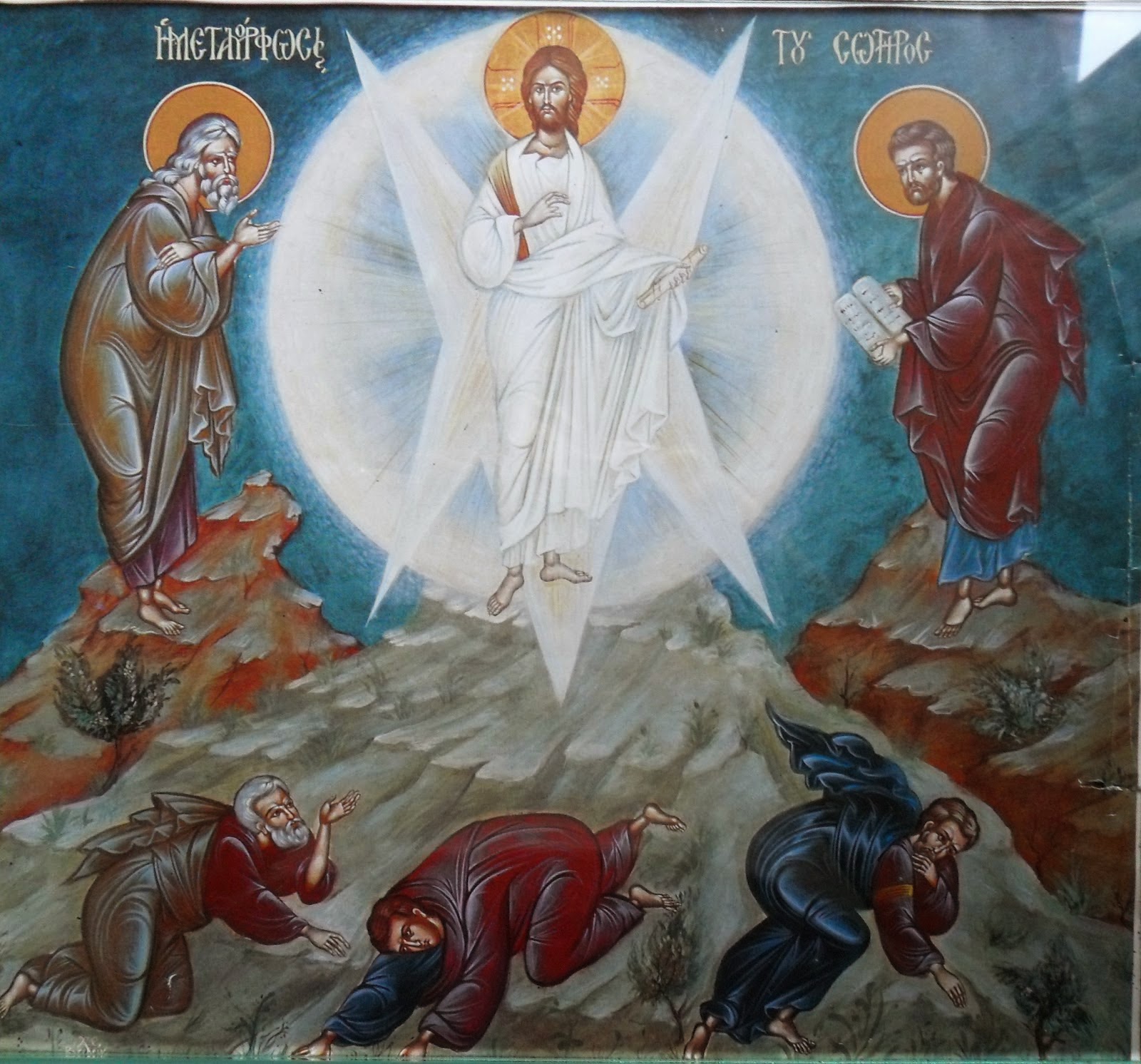
After all Elijah as carried up to heaven by a chariot of light, and Moses who exuded divine light during his lifetime (as we read about in Exodus) and whose body eventually transformed fully into colorful light when he died, according to some legends. So when Peter, James, and John see two other mysterious men bathed in glorious light next to a wonderfully transfigured Jesus, they were wise to deduce their identities to be that of Moses and Elijah. 


John the Evangelist uses the expression God is Light (1 Jn 1.5) In the Orthodox tradition presented in first-hand accounts in Symeon the New Theologian, Seraphim of Sarov, Archimandrite Sophrony, a this is an experience of the ‘Uncreated Light’, the divine energies, and is a foretaste of union with God, ‘deification’ or theosis.

Many believe this is how the Shroud of Turin was created.

Valuable research has been carried out by Paolo Di Lazzaro and others on the colouration of linen by ultra-violet radiation. In 2010 the researchers concluded that:

“Our results demonstrate that a short and intense burst of directional deep-UV radiation can provide a linen colouration having many peculiar features of the Turin Shroud image, including hue, colouration of only the outer-most fibres of the linen yarns and lack of fluorescence”


In April 2019 a paper in Applied Optics described how femtosecond pulse laser processing in the infrared came close to reproducing a 2-dimensional image of the face on the Shroud.

It seems therefore that different radiation in different frequencies can produce some of the characteristics of the image, but to date there has been no successful attempt to produce the image in its entirety. This research has used radiation in frequencies close to that of visible light.
Dr. Silverman is a leading scientific expert on the so-called Shroud of Turin, which is the cloth traditionally said to be the burial shroud of Jesus and which holds an imprint of his face. 

In his book, A Burst of Conscious Light. Near-Death Experiences, the Shroud of Turin, and the Limitless Potential of Humanity, he presents with evidence that this imprint actually was produced by a blast of radiation which the author links to the light of consciousness itself. Similar phenomena have been observed in relation to Near-Death-Experiences and this leads us to reconsider the power of human consciousness and the laws of nature.


When researcher Fritz-Albert Popp (b. 1938) first discovered that all living cells emit light—biophotons—he could not have anticipated the revolution this would create in the fields of both biology and physics.

Apparently biophotons are used by the cells of many living organisms to communicate, which facilitates energy/information transfer that is several orders of magnitude faster than chemical diffusion. According to a 2010 study, “Cell to cell communication by biophotons have been demonstrated in plants, bacteria, animal neutriophil granulocytes and kidney cells.” 

Researchers were able to demonstrate that “…different spectral light stimulation (infrared, red, yellow, blue, green and white) at one end of the spinal sensory or motor nerve roots resulted in a significant increase in the biophotonic activity at the other end.” Researchers interpreted their finding to suggest that “…light stimulation can generate biophotons that conduct along the neural fibers, probably as neural communication signals.”

Stored in cell DNA, these messengers are the main communication network of the body, connecting cell parts, tissues, and organs.

Already they have been shown to regulate the growth, differentiation, and regeneration of cells. Coherent biophoton fields could prove to be the basis of memory and even consciousness, as suggested many years ago by Karl Pribram, David Bohm, and others.

Channels of light

An equally remarkable development is the re-discovery of the primo vascular system (PVS), after being overlooked for 30 years. This system of microscopic channels, which differ from the lymph, blood, and nervous tissues, qualifies as the actual tsa, nadi, or psychic channels utilized within Vajrayana, yogic, and Daoist traditions of meditation. The microscopic PVS is everywhere, even following the course of nerves and the brain itself.


Now, biophotons are photons, bits of light, that are generated spontaneously by most living cells. Research suggests that biophotons are created in the DNA that resides in the mitochondria in your cells. They are created in the 98% of each DNA molecule that is not used for genetic coding of behavior. The genome project referred to this as junk-DNA because they had no idea about its use.

Biophotons are important carriers of information in the brain, along with well-known electrochemical signals—neurotransmitters and nerve impulses (waves of ionic depolarization).

What this means is that each living cell is giving off, or resonating, a biophoton field of coherent energy. If each cell is emitting this field, then the whole living system is, in effect, a resonating field-a ubiquitous nonlocal field. And since biophotons are the entities through which the living system communicates, there is near-instantaneous intercommunication throughout. And this, claimed the original founder of biophotons Dr. Popp, is the basis for coherent biological organization — referred to as quantum coherence.


Well respected Biophysicist Mae-Wan Ho describes HERE how the living organism, including the human body, is coordinated throughout and is “coherent beyond our wildest dreams.”

 It appears that every part of our body is “in communication with every other part through a dynamic, tuneable, responsive, liquid crystalline medium that pervades the whole body, from organs and tissues to the interior of every cell.”

". . . the visible body just happens to be where the wave function of the organism is most dense. Invisible quantum waves are spreading out from each of us and permeating into all other organisms. At the same time, each of us has the waves of every other organism entangled within our own make-up. . . . We are participants in the creation drama that is constantly unfolding. We are constantly co-creating and re-creating ourselves and other organisms in the universe. . . "

There have been experiments that have studied the output of biophotons among people who are engaged in deep, contemplative practice, in heart-centered prayer in which one simply bathes in God’s love and light (like the prayer described in The Cloud of Unknowing). 

And the output of biophotons for people in deep prayer was extraordinary! Not just twice as much as the normal output, but hundreds of thousands of times more than the normal output. So, this suggests that when we are engaged in prayer and worship right here (when we are fulfilling our primary mission which is to glorify God), we are actually heightening a biological process that takes place in all of our cells. We are emitting biophotons of light from our bodies.

The knowledge that human DNA can be influenced and modulated by frequencies (sound, light, language, and thought) is likely to have been known to various spiritual traditions, mystics, and teachers over the ages. This is perhaps why a variety of exercises have existed that utilize thought focus (prayer), sounds (music, chanting, singing), light (both natural light and produced light, such as in stained glass), and language (specific recitations such as a mantra and zikr).


This is very evident in Sufism, read HERE


The Dua Of Light; the Prophet (saws) often prayed in Sujood, “O Allah, place light in my heart, and on my tongue light, and in my ears light and in my sight light, and above me light, and below me light, and to my right light, and to my left light, and before me light and behind me light. Place in my soul light. Magnify for me light, and amplify for me light. Make for me light, and make me light. O Allaah, grant me light, and place light in my nerves, and in my body light and in my blood light and in my hair light and in my skin light.” (Bukhari)

One of the most treasured practices of the Sufi path is zikr, the remembrance of Allah. To be in unity with Allah is to be in a constant state of remembrance of the source of all creation.

The various names of Allah are repeated several, often hundreds of times in unison by a group in the exactas of adoration. Certain movements, such as swaying back and forth or turning from right to left, are incorporated into the activity during the intonations, and are likewise performed in unison. In some tariqas a prayerful rotation of the whole body, arms extended while pivoting on one foot, is traditional.


And indeed, a study published found that Sufi's practicing Zakir, the Holy Names of God, emitted 100's of times more biophotons than normal, as Francis Tiso references in this interview.

https://www.youtube.com/watch?v=D-StGkzjVlM


Research at the University of Kassel in Witzenhausen, Germany, in 1997, showed that it is possible to produce visible light from the chest area under certain conditions. The first condition is that the meditation technique must be heart-centered, not transcendent. Secondly, a specific person with an actual need must be identified as a receiver of the transmitted light. Under these conditions, a sustained light emission of 100,000 photons per second was measured, where only the background count of 20 photons per second was observed without meditation.

That’s 100,000 biophotons vs 20 !

You can read the paper HERE or HERE “Visible Light Radiated from the Heart with Heart Rhythm Meditation” by P. Blair.

In full disclosure, this study has been controversial, with other scientists claiming this is impossible. It has not been replicated, however other studies of meditation has proven such practices induce increased Biophoton production, check out this paper HERE and on transcendental meditation HERE.
.

INVOCATIONS OF DIVINE LIGHT

These are Sufi meditations that use chanting, out-loud and silently, to create vibrations that stimulate the heart and third eye. Specifically, the Arabic words Nur and Mu-now-win are spoken slowly, with emphasis on the vowels, placing the resonance of the sound in the throat and chest. They produce the sensation of having a miniature sun in the chest.

DIHKR

The repetition of the Arabic phrase, "La illaha illa 'llah Hu" is an ancient prescription for entering into the consciousness of the One and Only Being. It is performed with attention on the heart as the center of the experience and results in a feeling of profound heart-centeredness.

The great Sufi Scholar Henri Corban wrote in The Man of Light in Iranian Sufism about the divine inner light, the “Sun of the heart,” the Sun of the mystery,” the “Sun of the Spirit,” the “initiatic light.”

For Suhrawardi, the quest culminated in the visio smaragdina, the outburst of emerald light heralding ‘the secret of the mystery of Mysteries.’ The emerald light is described in Revelation:

“round [God’s] throne was a rainbow that looked like an emerald.” 

This re-ascent of light to light, the ascent of the ‘column of Light,’ this mystical experience fills a function of cosmic salvation. “To attain fully to this Illumination is salvation.”

Corbin emphasizes that “the terms light and darkness, clarity and obscurity, are neither metaphor nor comparisons. The mystic really and actually sees light and darkness, by a kind of vision that depends on an organ other than the physical organ of sight.”


In any case, the “body of light” is well alive in religious traditions.

See also -

Yan Sun, Chao Wang, Jiapei Dai. Biophotons as neural communication signals demonstrated by in situ biophoton autography. Photochem Photobiol Sci. 2010 Mar ;9(3):315-22. Epub 2010 Jan 21. PMID: 20221457

F A Popp, W Nagl, K H Li, W Scholz, O Weingärtner, R Wolf. Biophoton emission. New evidence for coherence and DNA as source. Cell Biophys. 1984 Mar;6(1):33-52. PMID: 6204761